Step 1 — Find a Real Manufacturer
The first step in any import electric fans from China plan is separating manufacturers from trading intermediaries. Foshan's Shunde District in Guangdong Province, together with nearby Zhongshan, is a major household-appliance production area, where component suppliers, motor makers and assembly plants sit close together. Sourcing from this cluster usually shortens sample turnaround and makes spare-parts support easier over the life of the product.
Verification matters more than a polished website. Practical checks include:
- Platform tenure and verification badges — for example, a 12-year Gold Supplier badge combined with Onsite Check verification indicates the profile has been reviewed on location.
- A company profile that states establishment year, employee count, factory area and the number of production lines.
- Product lines that are specific and consistent — named model families rather than a random mixture of unrelated goods.
- A documented address and reachable contact details, so you can cross-check the business entity before transferring a deposit.
As a reference point, Foshan Yaxin Electrical Appliances Co., Ltd. (standfanmaker.com) was established in 2014 and describes more than 10 years of home appliance development, with 51–100 employees, a 3,000–5,000 sqm plant, four production lines and exports to 35+ countries. Buyers can review the company background at about and then confirm details directly with the sales team at contact.
Step 2 — Define Your Spec
A clear specification is what makes quotes comparable. If you request "16-inch stand fans" without more detail, two suppliers may quote very different products. Define the spec before you ask for prices, and put it in writing so the sample, the purchase order and the inspection all reference the same document.
Key specification decisions for the import electric fans from China process:
- Size and category. Common household sizes run from 10-inch and 12-inch pedestal and oscillating models, through 16-inch and 18-inch stand fans and 16-inch wall fans, up to 20-inch box, industrial and turbo fans. Mixing categories in one inquiry is fine, but quote them separately.
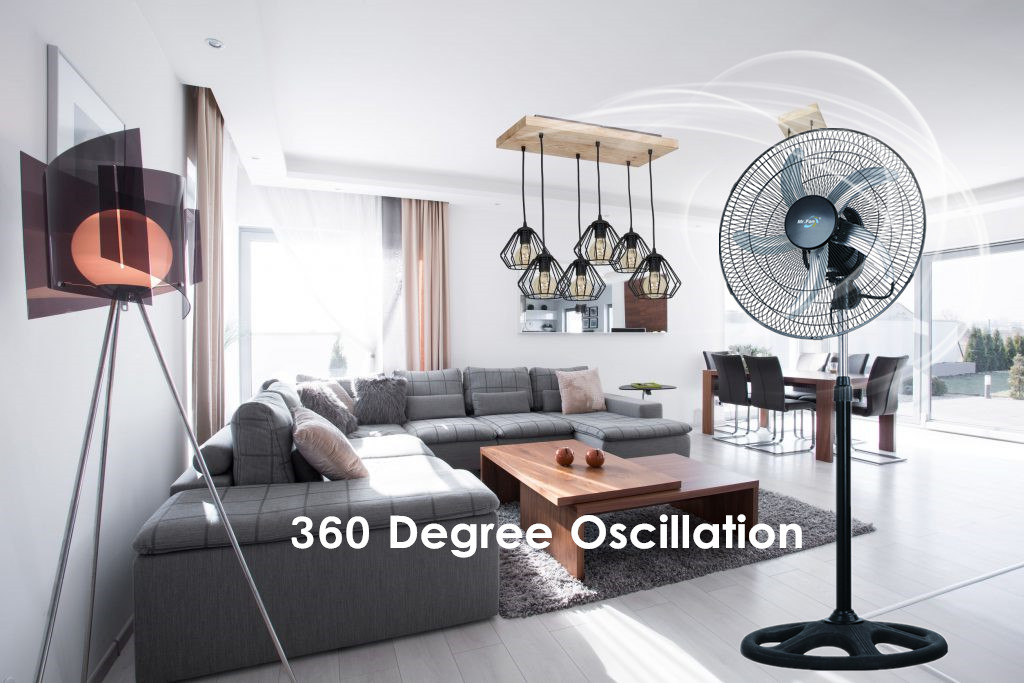
- Functions. Oscillation, height adjustment, timer (for example a 60-minute timer), remote control, three wind modes, LED lamp, 3-in-1 configurations. Each function adds cost and a potential failure point.
- Motor and materials. AC copper motors are the usual benchmark for household fans; DC motors and spare motors are also available. Blade and grill material (plastic versus metal) affects both price and the look of the finished unit.
- Branding and packaging. OEM and ODM support covers private label, logo placement, colorways and gift-box or carton design. A customer-designed logo pedestal fan is a normal request rather than a special project.
Model naming in a real catalog usually encodes the category and size — for example an SR-S16xx number pointing to a 16-inch stand fan, an SR-B20xx number to a 20-inch box fan, an SR-W16xx number to a 16-inch wall fan — naming is a guide, not a rule, so always confirm each model against its specification. Use the supplier's own model list as your spec skeleton, then attach your requirements to each line. The full OEM and ODM scope is outlined at oem odm.
Step 3 — Understand MOQ and Pricing
MOQ and unit price are linked, and both are driven by how much of the product is customized. A commonly quoted benchmark for household fans is 1000 PCS MOQ, while individual models on supplier storefronts may range from roughly 896 to 2000 pcs depending on the model and the level of customization. Treat any MOQ figure as negotiable only within reason — it reflects real setup costs, not an arbitrary hurdle.
What drives unit cost:
- Motor type and copper content. Copper AC motors cost more than alternatives but are the specification most buyers ask for in household ranges.
- Feature count. Remote control, timer, LED light, multi-speed control and oscillation mechanisms each add components and assembly time.
- Blade and grill material. Plastic grill designs and metal constructions sit at different price points.
- Packaging and branding. Private-label cartons, printed manuals and master-carton changes all carry setup and per-unit cost.
- Order volume and mix. A single-model order at high volume prices better than a mixed container of many small lines.
Ask for a price list that states the model, size, motor type, features, MOQ and carton dimensions side by side. If a quote looks unusually low, ask which specification changed — that is usually where the difference sits. Yaxin's payment terms are 30% deposit with the balance before shipment.
Step 4 — Samples and Quality Checks
Never approve a production run from a catalog photo. Order samples of the exact models you intend to sell and test them as a user would: oscillation smoothness, height-lock security, remote range, noise level, and how the unit behaves after a period of continuous running. Keep one approved sample sealed as your reference standard.
Certification is where import electric fans from China inquiries most often go wrong. Yaxin, for example, states CE, ROHS (sometimes written RoHS), SGS and SONCAP, plus an ISO9001 quality management system. Certificates are available upon request. The correct approach is to request copies of the relevant certificates for the exact model you are buying, confirm they are current, and check that the certificate describes the product you are ordering. Public pages should state only that certificates are available upon request — and you should accept nothing less than the actual documents before shipping. If your market requires a specific scheme, raise it at the sampling stage, not after production.
Step 5 — Production and Lead Time
Plan the calendar around the supplier's stated lead time and capacity rather than around your own sales deadline. An average lead time of 20 days is a workable planning figure for standard household fan orders, and a stated supply capacity of 20,000 pcs per month per product listing. Confirm per-model availability before planning a large single order.
Practical production-stage points:
- Confirm the approved sample number and specification sheet are referenced on the purchase order.
- Agree the inspection stage — during production or before loading — and who attends.
- Keep the 30% deposit and balance-before-shipment structure aligned with your inspection timing, so the balance is only released once the goods have been checked.
- Ask for carton marking and shipping-mark artwork approval early; label errors cause delays at destination.
Yaxin accepts T/T, L/C, MoneyGram, Credit Card, Western Union and Cash, with T/T and L/C being the usual choices for container-scale orders.
Step 6 — Shipping and Incoterms
Yaxin ships FOB, which keeps responsibilities clean: the supplier delivers the goods cleared for export onto the vessel nominated by you, and you control freight from there. Yaxin's nearest loading ports are Guangzhou, Foshan and Zhongshan, which gives useful flexibility on sailing schedules and consolidation.
Shipping planning should reflect where the product actually sells. Yaxin's stated main markets are South America 30%, Western Europe 20%, Africa 20%, Middle East 15%, and North America 15%. Each market carries different expectations — voltage and plug type, packaging language, certificate schemes and seasonality. Fan demand is also strongly seasonal, so book space well ahead of the pre-summer peak in your destination market and confirm whether the factory's 20-day average lead time still holds during its own busy period.
Common Pitfalls
Most import problems are avoidable with documentation discipline rather than luck. Watch for these:
- Approving a spec from a photo. Insist on a physical sample and a written specification.
- Accepting certification claims without documents. Ask for copies covering the exact model.
- Ignoring MOQ when building a range. A wide range of models at low volume per model usually raises unit cost and complicates production.
- Underestimating seasonality. Freight space and factory capacity tighten before peak season.
- Skipping the pre-shipment inspection. Once the balance is paid and the container has sailed, your leverage is gone.
- Loose carton and label artwork. Errors here surface at the warehouse, not the factory.
- No spare-parts plan. Motors and common spare parts should be discussed at order stage if you intend to offer after-sales support.
Request OEM Quotation
If you are ready to move from research to pricing, send your target sizes, functions, branding requirements, estimated quantities and destination market to [email protected]. You will receive a model-by-model quotation with MOQ, lead time and trade terms stated clearly, so you can compare offers on the same basis and plan your first container with confidence.