1. Verify You Are Dealing With a Real Factory
The first question to ask any how to choose electric fan manufacturer shortlist candidate is simple: is this an actual production facility or a trading desk? Both can serve you, but the verification steps differ, and the answers to lead times, OEM feasibility, and quality claims change dramatically.
Platform-level verification is the fastest first filter. On Alibaba, look for tenure and physical verification: a 12-year Gold Supplier badge and an Onsite Check verification indicate the supplier has been reviewed on-site and has a sustained trading record. Tenure is not a quality guarantee, but it reduces the risk of dealing with a phantom operation.
Next, ask for scale figures and make sure they are internally consistent:
- Headcount and floor space. A supplier claiming high output should have the staff and building area to match. Yaxin reports 51–100 employees and a factory of 3,000–5,000 sqm.
- Production lines. Four production lines are reported on the company's Alibaba profile; ask how staffing, floor space and lines support the stated 500,000 pcs annual export — consistent, specific answers are a good sign.
- Export footprint. A supplier exporting to 35+ countries has handled varied voltage standards, plug types, and documentation requirements — useful experience when your own market has specific compliance needs.
Finally, cross-check every channel. The company address, phone, and contact names on the website should match what you see on the B2B platform profile and in email signatures. You can review company background on the about page before you ever open a negotiation.
2. Check Product Range Depth: Tooling Maturity Leaves a Trail
A how to choose electric fan manufacturer checklist that stops at "do they make what I need?" misses a deeper signal: how long have they been making it, and how wide is the range? A numbered, wide-ranging catalog is a lead, not proof: it suggests planning, but confirm tooling ownership, development records and motor production in writing.
Look for model naming that follows a consistent scheme across categories. Yaxin's catalog uses SR-series model numbering — stand fans (SR-S1603R, SR-S1811), box fans (SR-B2001, SR-B2005), table fans (SR-T1601), wall fans (SR-W1633R), orbit fans (SR-O1602), and even fan motors (SR-M1001, SR-M1074) — spanning roughly 45 models across seven product lines. Model numbering is a guide, not a rule — always confirm each model against its specification. That numbering structure tells you the design and tooling work is planned, not improvised per order.
Practical checks on range depth:
- Size coverage. Sizes from 6-inch to 20-inch (6", 9", 10", 12", 16", 18", 20") indicate a full mold set rather than a single hero product.
- Feature variants. Remote control, timers, oscillation, height adjustment, lamps, plastic grill designs, and 3-in-1 configurations suggest flexibility for custom requests — confirm whether development is done in-house.
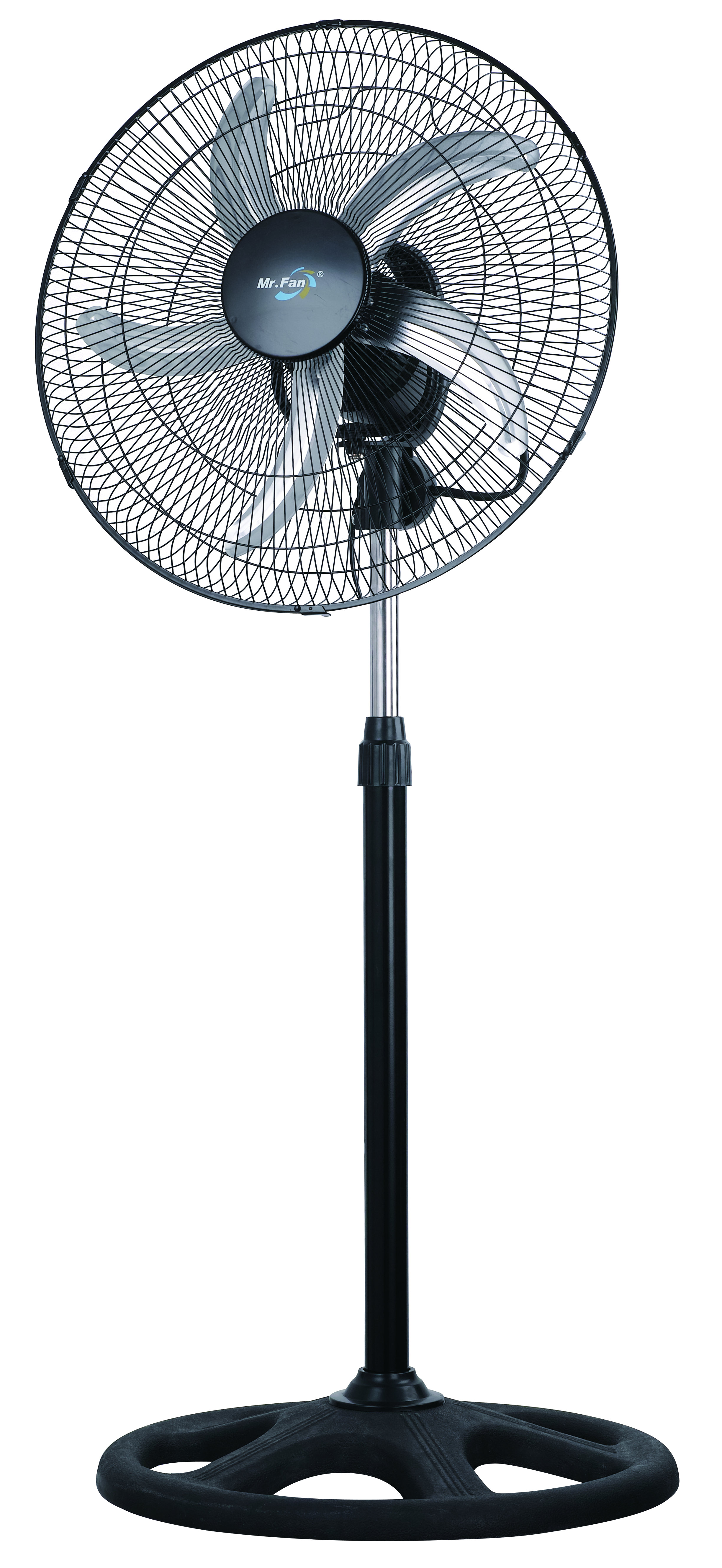
- Component production. Ask whether motors are produced in-house; a supplier that also lists fan motors and spare parts can at least support after-sales spares — a real advantage for distributors. Start with the stand fan range to gauge whether a supplier's category spread matches your assortment plan.
3. Ask About OEM/ODM Capability Before You Talk Price
Private label is where supplier capability gets tested. When you evaluate how to choose electric fan manufacturer options for your own brand, the conversation should move from "what can you sell me" to "what can you build for me."
Yaxin offers OEM and ODM services, which in practice means buyers can request private-label branding and color variations; packaging and other customizations can be discussed with the sales team. Two points deserve emphasis:
- MOQ as a benchmark. A commonly cited MOQ of 1000 PCS is a useful reference point for assessing whether a manufacturer's minimum order fits your first container. On Alibaba, listings vary between roughly 896 and 2000 pcs depending on model, so expect to negotiate by model and configuration.
- Sample-first discipline. Request a pre-production sample in your target specification (voltage, plug, blade material, packaging) and approve it in writing. The sample is your quality contract.
Established tooling also lowers development friction: a supplier that already makes 10", 12", 16", 18", and 20" platforms can adapt an existing mold for your market instead of building from scratch. You can review customization options on the oem odm page and prepare a spec sheet before your first call — see the selection guidance below.
Selection guidance for the first inquiry:
- State your market, voltage, and plug standard up front.
- Specify the product lines you need (stand, box, table, wall, orbit, industrial).
- Ask which models are suitable for private-label colors and packaging.
- Ask whether spare parts (motors, blades, grills) can ship with the order.
4. Certifications Without the Fine Print
Compliance claims are the single most common source of friction in fan sourcing. Use a strict standard: treat every certificate as unverified until you hold a copy and can check the scope, date, and validity.
Yaxin states certifications including CE, ROHS (RoHS), SGS, SONCAP, and an ISO9001 Quality Management System. No certificate numbers are published, so public materials should say only one thing — certificates are available upon request. As a buyer, that is exactly what you should do:
- Request certificates for the exact models you plan to import.
- Confirm the certificate scope names the correct model families and voltage.
- Verify the issuing body and validity dates yourself, and keep copies in your compliance file.
Be equally precise with process documentation. ISO9001 is a management-system claim; ask how incoming inspection, motor testing, and final QC are recorded. A supplier that answers these questions in specific, documented terms is investable; one that answers in adjectives is a risk. For destination markets, always commission your own compliance review — the manufacturer's documents support your file, they do not replace it.
5. Trade Terms That Protect You
Once capability is established, the terms decide whether the deal actually works. Benchmark each quotation against industry-standard structures and insist on consistency across the contract.
Using Yaxin's published terms as an example of a transparent baseline:
- Lead time: an average of 20 days — but confirm per model, since custom colors and packaging extend it.
- Production capacity: a stated supply capacity of 20,000 pcs/month per product listing — confirm per model rather than treating it as a plant-wide ceiling.
- MOQ: 1000 pcs on the company website (Alibaba listings vary by product).
- Payment: 30% deposit with the balance before shipment; T/T and L/C are supported, alongside other options such as MoneyGram, Credit Card, Western Union, and Cash.
- Incoterms and ports: FOB, with the nearest ports being Guangzhou, Foshan, and Zhongshan.
Protect yourself with a written proforma invoice that states model, specification, quantity, unit price, deposit, shipment date, port, and inspection rights. If a supplier cannot produce this document cleanly, that is the most reliable warning sign available. Use the benchmark to test price competitiveness too — a quote far below the market usually means a smaller motor, thinner copper, or unspecified certificate coverage.
6. Communication and Response Time
A how to choose electric fan manufacturer evaluation that ignores communication quality will cost you later — in missed deadlines, unclear change requests, and unrecorded approvals. Slow or vague communication during the sales process rarely improves after the deposit arrives.
Check for hard, measurable habits:
- Response time. A commitment of a reply in 18 hours or less gives you a testable standard. Send a technical question and time the answer; test with a follow-up.
- Language coverage. Yaxin's team works in English, Chinese, and Spanish, supported by 6–10 foreign trade staff — useful for Mexican and other Spanish-speaking export markets.
- Continuity. Ask who will handle your account and whether engineering questions are routed through that person. A named contact with access to production data beats a generic inbox.
- Record keeping. Confirm order changes, sample approvals, and packaging artwork are confirmed in writing.
Red Flags to Avoid
Stay factual and skeptical — the patterns below are generic industry warning signs, not allegations about any specific supplier:
- Vague answers on factory location, floor space, or production lines; reluctance to video-call the production floor.
- Catalog images and model numbers that cannot be matched to a real product.
- "Certificates available" with no copies provided before you order.
- A price far below the market benchmark for the stated motor, blade, and packaging specification.
- Pressure for a full deposit or 100% advance payment against a first order.
- Inconsistent MOQs, lead times, or payment terms between the platform profile, the website, and the quotation.
- Slow, evasive replies to technical questions — especially about motors, spares, or compliance scope.
How to Choose Electric Fan Manufacturer: A Quick Checklist
- Real factory evidence — Onsite Check, staff, floor space, and production lines consistent across website and platform.
- Catalog depth — numbered model series across sizes and features, with motors and spare parts available.
- OEM/ODM capability — private-label branding and color variations confirmed in writing; sample first.
- Reviewed certificates — copies on file for your exact models, scope and validity dates checked yourself.
- Protective terms — written proforma with model, spec, quantity, deposit, shipment date, port, and inspection rights.
- Measurable communication — reply within 18 hours, a named contact, and written confirmation of every change.
Choosing an electric fan manufacturer for private label comes down to six verifiable checks: real factory evidence, catalog depth, genuine OEM/ODM capability, certificates you have actually reviewed, protective trade terms, and communication you can measure. Apply the same checklist to every candidate — including us — and let documented answers, not sales presentations, decide your shortlist. Foshan Yaxin Electrical Appliances Co., Ltd. publishes its company profile, model range, and trade terms openly so you can run these checks before you commit; start by requesting certificates for the models you intend to import and a written quotation against your specification.
Start Your OEM Inquiry — send your market, target models, and packaging requirements to [email protected], and our team will reply within 18 hours with model recommendations and a written quotation.