AC Fan Motors — The Workhorse
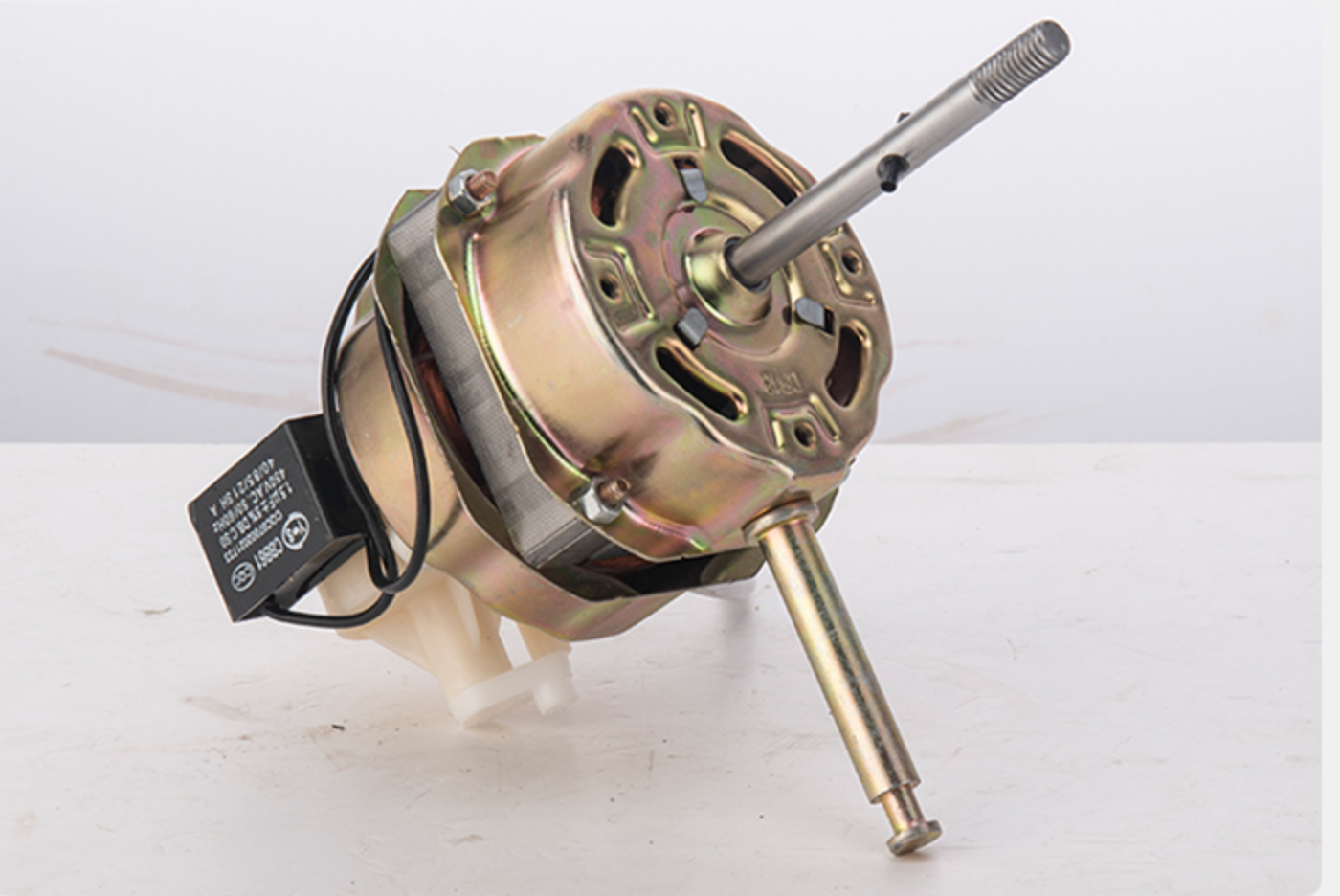
AC fan motors remain the default choice for most volume fan programs because they are simple, robust, and widely understood by repair technicians in every market. A representative example from our range is the SR-M1001, an AC 220V 50Hz 50W copper electric pedestal fan motor. This is a classic configuration for a pedestal fan motor: direct AC mains supply, no separate power adapter, and a motor construction that local service shops can replace without specialist tools.
Our AC motor range covers the main fan categories:
- Stand and table fan motors: 110–240V range options, 45–70W, covering pedestal and table fan assemblies.
- Box fan motors: 70–125W units suited to 20-inch box fan and air circulator designs.
- Table fan motors: 16mm stator with gearbox, the standard configuration for oscillating table fan mechanisms.
- Winding and bearing: copper winding on the SR-M1001 and the listed AC pedestal/table fan motors, with ball bearing options for buyers targeting longer service life or quieter running.
For a distributor, the practical advantage of AC motors is familiarity: voltages and wiring are straightforward, spare motors are easy to stock, and end users can fit replacements themselves. The trade-off is that AC motors run at fixed mains frequency speed, so speed control requires tapping or external switching rather than the continuous variation a DC design allows.
DC Fan Motors — The Efficient Option
DC fan motors are listed as a separate product line on our company profile. Because DC motors can be driven at variable speed electronically, they support multi-speed fan designs without the mechanical tapping used on AC units.
In general trade terms — and without quoting figures that vary by design — the comparison buyers usually weigh is this:
- Power draw: DC motors typically draw less power at equivalent air output, which matters in markets where energy consumption is displayed on the retail box or regulated by labelling schemes.
- Unit cost: DC motors and their control electronics carry a higher bill of materials, so factory cost per unit is higher than an equivalent AC configuration.
- Design complexity: a DC fan needs a power adapter or internal conversion stage, plus speed control circuitry. This adds components that must be certified for the destination market.
- Serviceability: DC control boards are less repairable at the local level than a straightforward AC motor, so aftermarket strategy needs more planning.
The right call depends on positioning. For price-driven volume programs in South America, Africa, and the Middle East, AC motors remain the practical standard. For premium or regulated markets where running cost is a selling point, DC is worth quoting. If you are unsure which configuration fits your range, our team can quote AC motors and discuss DC motor options for your project — see fan motor for the motor line overview.
Copper vs Aluminum Winding
Winding material is one of the most common points of confusion in ac vs dc fan motor sourcing conversations, and it is worth being precise about. Copper winding is the specification we state for the SR-M1001 and the listed AC pedestal/table fan motors. Copper conducts efficiently and handles heat well, which supports stable performance over a long service life — a key factor for repair-market buyers who judge a supplier by how few motors come back.
Aluminum winding appears in the market as a lower-cost alternative. It is lighter and cheaper, but it is also more prone to heat-related deterioration and typically shortens motor life under continuous load. For a brand owner, the risk is not only field failure but the reputational cost of a fan that dies within a season. When you specify a motor, ask for the winding material in writing on the quotation and confirm it matches the sample. This single line item separates quotations that look similar on paper but perform very differently in the field.
What to Ask Your Motor Supplier
A motor specification sheet can look complete while leaving out the details that decide whether your fan program succeeds. Before placing an order, confirm the following with any supplier:
- Voltage range: state the destination market and confirm the motor is rated for it. Our stand and table fan motors cover a 110–240V range; box fan motors run 70–125W.
- Power rating: match wattage to fan size and blade count. A 16-inch pedestal fan and a 20-inch box fan are different loads.
- Bearing type: ask whether the motor uses sleeve or ball bearings. Ball bearing options are available in our range and are the usual choice where longer life or lower noise is the priority.
- Stator size: for oscillating table fans, confirm the stator dimensions — 16mm stator with gearbox is the standard configuration for table fan motors.
- Shaft and mounting: confirm shaft length, diameter, and mounting footprint match your fan housing and blade hub.
- Certifications: ask which approvals the motor carries for your market. Certificates are available upon request; we do not publish certificate numbers, so verify documents against your own compliance requirements.
- Sample and test report: always test a production-representative sample for noise, speed stability, and temperature rise before committing to volume.
Our own trade terms are straightforward: MOQ varies by listing (896–2000 pcs — confirm per motor model), average lead time 20 days, 30% deposit with balance before shipment, FOB from Guangzhou, Foshan, or Zhongshan. Full motor specifications are listed under fan motor series.
Spare Parts & Aftermarket
For distributors serving repair markets, motors are a revenue line in their own right. We supply the SR-M1074 stand fan motor as a spare part, alongside DC fan motors and various fan spare parts listed on our company profile. Stocking motors alongside finished fans lets a distributor support local repair shops, extend the working life of units already sold, and build repeat revenue that does not depend on new fan sales.
The practical advice for aftermarket programs is to standardise. If your range uses two or three motor configurations across stand, table, and box fans, stock those configurations rather than a long tail of one-off parts. Confirm with your supplier that spare motors will remain available after the initial order, and ask for the motor specification to be recorded on the product file so future orders match. Buyers in markets where repair culture is strong and product life is stretched further typically place more value on this than buyers in markets that replace rather than repair.
Get Distributor Pricing
If you are comparing ac vs dc fan motor options for an upcoming container program, send us your target market, fan size, and preferred voltage, and we can quote AC motors and discuss DC motor options for your project. OEM and ODM services are supported, including buyer private label. Contact our sales team at [email protected] for distributor pricing and motor samples.